A home for Science, Technology, and Slackware.
Recent Updates
Slackware64-Current (15.0): mini-ITX Benchmarks Part 2
Posted on Dec 31, 2019 by kingbeowulf
To close out the old and ring in the New Year, I've added my EVGA GTX 1060 6GB GPU to the benchmark comparison. Both the GTX 1060 and GTX 950 are short, single fan ITX form factor cards that will fit the mini-ITX case. We'll have to wait for CES 2020 to see what GPUs AMD announces, and what form factors manufacturers push out. Rumor has it the the second generation Navi will be twice as fast as the current Radeon 5700 XT series. I noticed that the XFX RX590 is a dual BIOS card with a switch - the "perf" run is with that switch set for a more aggressive fan curve (1660+ rpm at idle) vs. quite mode (880 rpm). It didn't provide a significant performance increase but did keep the GPU about 10C cooler. All runs were with VSYNC off but all other settings (driver and phoronix) at default values.
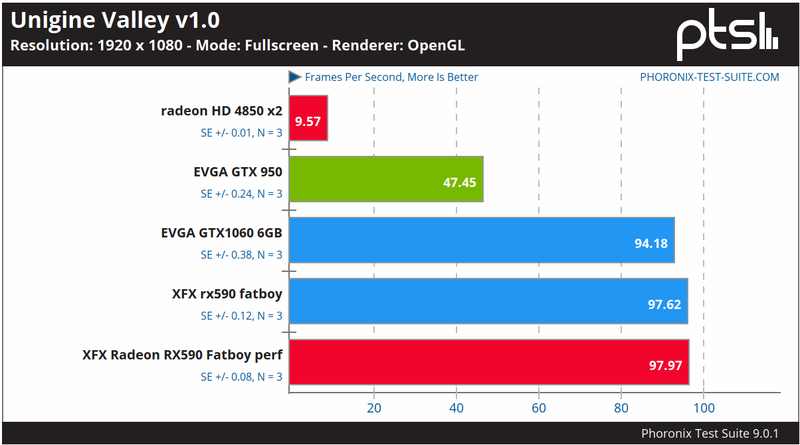
The RX590 ekes out a few more fps over the GTX1060, but generally the performance is nearly equivalent.
Read more...
Slackware64-Current (15.0): mini-ITX Benchmarks Part 1
Posted on Dec 22, 2019 by kingbeowulf
Here are some initial Phoronix-test-suite benchmarks for the miniITX Rysen 7 with various GPUs I had on hand. For Nvidia, we used the their proprietary driver; for AMD, the open source radeon and amdgpu drivers provided in Slackware64-current kernel 5.4.2, 5.4.3, 5.4.5 (nvidia, radeon, amdgpu, resprctively - Slackware updates were fast and furious this week!).
The CPU cooler is a low profile SilverStone SST-KR01 so that the power supply would fit. Power is provided via a Rosewill HIVE 650S 650W ATX power supply. The Nvidia EVGA GTX 950 is an ITX form factor GPU; and thus, the results are with the case closed. The 2 radeon GPUs are huge and are attached via a PCI-E riser with the case open.
Phoronix Test Suite from Slackbuilds.org; stock KDE4; system and tests use default settings. For the RX590, the "HIGH" run references setting the GPU power management to "high" from the default of "auto".
Read more...
New Slackware64-Current (15.0) test build: AMD Ryzen 7 3800X and mini-ITX
Posted on Dec 15, 2019 by kingbeowulf
It was a shame to toss a perfectly good mini-ITX case (Coolermaster Elite 110), so with the assistance of a mysterious benefactor, and fellow Slackware fan, I now have the components:
Read more...
The HP d530 Pentuim 4 is dead; Long live the Lenovo M91p i5-2400s
Posted on Sep 30, 2019 by kingbeowulf
It was only a matter of time, I suppose, but my old Pentium 4 box used as a hobby server is no more. A fast thunderstorm with hail moved through our area. Of course, we lost power for several hours. Rather than hope the UPS will last long enough, I powered the ol' box down. Unfortunately, the P4 had issues powering up and booting. When it did boot, it was missing some memory and a had number of other motherboard glitches. I was planning on moving everything to the M91p with the release of Slackware64-15.0, anyway.
It is time.
Welcome our "new" server!
[UPDATE: Now running on a Slackware Linode with Wagtail CMS. -KB Jan 2, 2021]
Read more...
The Witcher 2: Assassins Of Kings Enhanced edition on Slackware64
Posted on Sep 15, 2019 by kingbeowulf
I purchased this game on sale at GOG.com a while back (2014?) when I was exited about the Linux port, and before I realized it used the wrapper eON translation layer. (We can quibble over wrapper vs API vs etc here: PSA: eON is not a wrapper).
I'll just say that native linux code would be better.
Performance with Slackware64 multilib with Nvidia GTX 660 was poor: crashes, video glitches, lags, sudden fps drops. I was barely able to complete the tutorial section. A few patches were released that improved performance. There was also github project that tracked Linux updates and performance tweaks which now seems to be gone. I put the game aside for awhile to let it mature.
GOG.com updated Witcher 2 to Release 3, and it is officially tested on Ubuntu 16.04 LTS, Ubuntu 18.04 LTS, and variants. Non-Ubuntu Linux distributions are not officially supported - as in no technical support or refund. As a Slackware user, I have found that par for the course. Here are some notes on giving Witcher 2 another go.
Read more...
Older posts..